Automated SEO with AI: How to Optimize Content Without Experts

4 min. read

Discover how automated SEO with artificial intelligence transforms content creation: keyword research, competitor analysis, optimized text generation and internal linking in a single pipeline integrated into the CMS.

Automated SEO with AI: How to Optimize Content Without Experts

SEO with artificial intelligence integrated into the CMS: audits, SERP analysis and more readable content. To climb to the first page and be cited by AI.

What is Automated SEO and Why You Need It in 2026

Automated SEO — also known as SEO automation or automatic SEO — uses software and artificial intelligence to perform repetitive SEO tasks. AI handles keyword research, competitor analysis, content drafts, meta tags, internal links, and reports. Strategy and final quality remain under human control.

In summary:

  • Automated SEO delegates repetitive tasks to AI: data analysis, keyword clustering, drafts, and reports
  • Reduces time and costs compared to manual SEO
  • Always requires human oversight on strategy and quality
  • Integrated into the CMS, it covers the entire workflow: from keyword research to publication

Why is it needed in 2026? Because manual SEO can no longer keep up with the pace:

  • Google updates its algorithm hundreds of times a year
  • Every niche has dozens of active competitors
  • Superficial content no longer ranks
  • A dedicated SEO expert has prohibitive costs for SMEs and freelancers

SEO automation tools solve these problems. AI analyzes, generates drafts, and optimizes in just a few minutes. A SEO orchestration platform like AraLith COS governs the entire workflow. The result: more published content, better rankings, reduced costs.
How an End-to-End Automated SEO Pipeline Works

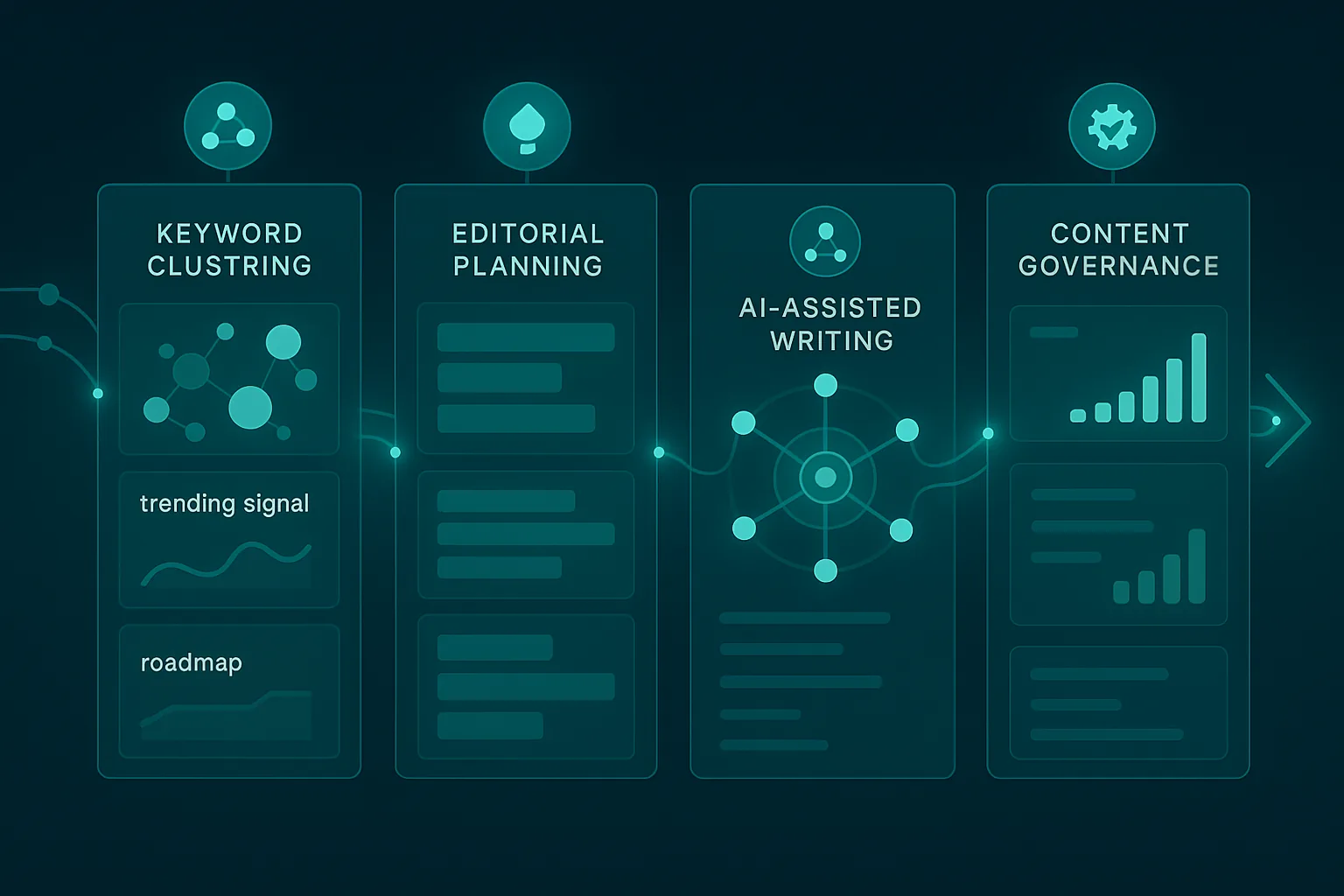
  • Automated Keyword Research

    AI SEO tools query databases like Ubersuggest. They retrieve search volume, difficulty, and CPC. Then they select long-tail keywords with high potential and low competition.

  • SERP and Competitor Analysis

    The AI downloads the top 10 Google results and analyzes them: titles, meta descriptions, headings, and keyword density. This reveals the patterns that work.

  • Editorial Plan Generation

    The AI generates a complete outline: H1, H2, H3, introduction, sections, FAQ, and CTA. Every block respects the search intent and related keywords.

  • Content Writing with Verified Sources

    The AI writes the text based on approved sources. An anti-overclaim system blocks unverified statements. The content comes out ready for publication.

  • Meta Tag and Internal Linking Optimization

    The AI generates SEO titles, meta descriptions, and image alt texts. It also suggests internal links. Everything optimized for CTR and rankings.

  • Publishing and Monitoring

    The content goes live as a blog post or CMS page. SEO automation monitors rankings, traffic, and conversions. It then suggests subsequent optimizations.

What Can Be Automated in SEO and What Cannot?

SEO automation reduces working time, but does not eliminate human judgment. The division of tasks is clear: repetitive activities go to AI, while strategy and quality remain with people.

What you can automate

  • Keyword research and clustering: AI groups similar keywords, even on large amounts of data
  • Technical audit: finds broken links and site crawl errors
  • Content drafts: prepares starting texts and meta tags to be refined
  • Reporting: collects traffic and rankings in periodic reports

What remains for the human team

  • Strategy and vision: brand objectives and editorial guidelines
  • Quality control: verifying that the text truly responds to the search intent
  • Final decisions: correcting logic or tone errors made by AI

A AI content governance system makes this control systematic: every claim is verified before publication.

How to Get Cited by AI Overview, ChatGPT, Claude and Perplexity?

AIs cite content they can easily extract and verify. Google's AI Overview and the deep searches of ChatGPT, Claude and Perplexity don't read pages like a user would: they look for short, structured answers backed by sources. Content is more likely to be cited if it has these characteristics:

  • Answer first: the definition appears in the first paragraph, not after three preambles
  • Citable blocks: "In summary" sections, bullet lists and FAQs that are easy to extract
  • Question headings: H2s and H3s that mirror real user questions
  • Verifiable claims: statements supported by sources and structured data (JSON-LD schema)

With an AI assistant integrated into the CMS these optimisations are applied directly at the writing stage. This is the approach of fourth-generation AI CMSs: systems designed to produce content ready for generative search.

The role of automated SEO audit

Applying these rules manually across dozens of pages is slow. An automated SEO audit with AI does the work for you. It analyzes every page and assigns three scores: classic SEO, AEO (Answer Engine Optimization) and GEO (Generative Engine Optimization).

For each page you receive concrete suggestions: where a "In summary" section is missing, which headings to turn into questions, which claims lack a source, where to add structured data. With the AI assistant in the page builder you apply corrections where you work, relaunch the audit and measure progress.

It's the same process used on this article: the AEO/GEO audit flagged the missing blocks and the page was optimized accordingly. An AI CMS that manages the entire content lifecycle makes this improvement a continuous cycle, not a one-off intervention.

The Numbers of Automated SEO

90%

Production Time Reduction

6x

More Published Content

100%

Optimization Consistency

Section label

The Advantages of Automated SEO for Agencies and SMEs

An AI SEO platform for agencies integrated into the CMS offers concrete and measurable advantages:

  • Drastic Time Reduction: from 4-6 hours to 30-60 minutes per complete article
  • Consistent and Scalable Quality: the same SEO best practices applied to every piece of content
  • Reduced Costs: a fraction of the cost of a senior SEO consultant
  • Data-Driven Decisions: real metric analysis for keywords with the best potential
  • Native Integration: from analysis to published content without switching platforms
Automated SEO dashboard with metrics and analytics

Frequently Asked Questions about Automated SEO

No. SEO automation handles repetitive tasks: keyword research, competitor analysis, content drafts and meta tags. An expert is still needed for strategy, link building and advanced technical SEO.

No, as long as the content is original, useful and based on verified sources. Google penalizes spam and low quality, not the use of AI. That's why AraLith integrates an AI governance framework with anti-overclaim verification.

The first results arrive within 2–4 weeks: indexing and first positions on long-tail keywords. For more competitive keywords, 3–6 months of consistent publishing are needed.

Yes. The pipeline generates product descriptions, category pages, buying guides and related articles. It integrates with the most popular e-commerce platforms, such as WooCommerce and Shopify.

Yes. AraLith natively manages multilingual sites. The integration with Ubersuggest covers the main languages: English, Spanish, French, German and Portuguese.

Manual SEO gives maximum control, but requires many hours and senior expertise. Automated SEO delegates repetitive tasks to AI and leaves strategic decisions to the team. For SMEs and agencies, a hybrid approach is almost always the most effective.

Just four: a crawler for technical audits, a keyword database like Ubersuggest, an AI agent for content and meta tags, and a monitoring dashboard. AraLith COS integrates them all directly into the CMS.

Automate Your SEO with AraLith

Complete SEO pipeline: keyword research, competitor analysis, content generation and automatic optimization. All integrated into the CMS.

Content created with the support of artificial intelligence.