AI Builders and Content Marketing Automation: the future of content creation

3 min. read

Schema-driven AI Builders and Agent Orchestration Layer are transforming content marketing. Discover how multi-phase workflows, controlled page builders, and human-in-the-loop accelerate production without losing control.

AI Builders and Content Marketing Automation: the future of content creation

How schema-driven AI Builders and Agent Orchestration Layer transform content marketing

Schema-driven AI Builders don't work with free prompts: they read available components, JSON schemas and build verifiable structures. The Agent Orchestration Layer coordinates multi-phase workflows while maintaining editorial control.

In summary

  • Schema-driven AI Builders first read available components and their JSON schemas, then build the page layout using only verifiable fields and values — they never invent arbitrary field names.
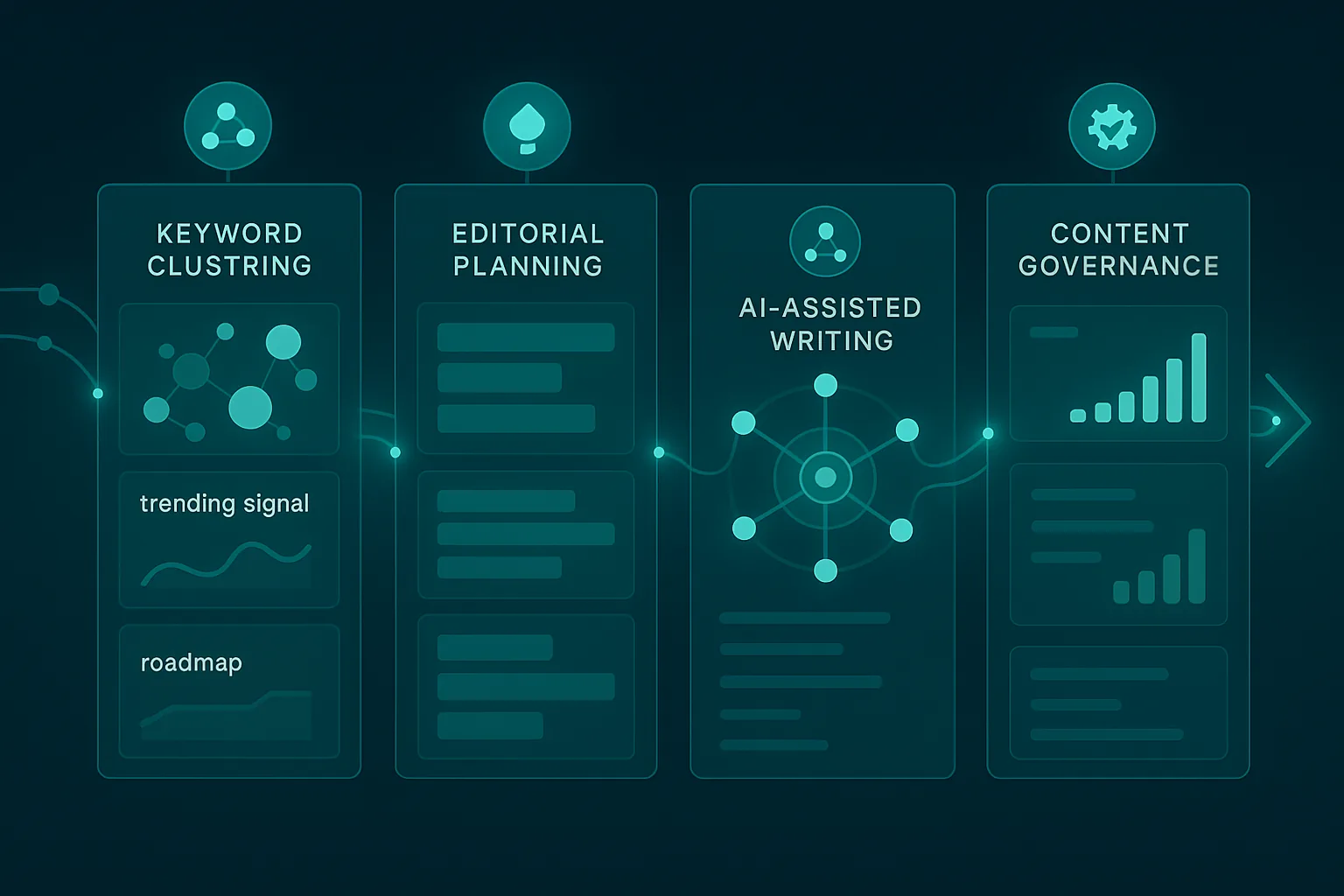
  • The Agent Orchestration Layer coordinates specialized agents for keyword research, competitor analysis, content generation and semantic validation in multi-phase workflows with decision traceability.
  • Content Marketing Automation with schema-driven AI accelerates production while maintaining editorial control: each component is validated against schemas, each claim against the Knowledge Layer.
  • The human-in-the-loop pattern ensures that AI supports SEO specialists and content teams without replacing strategy or editorial judgment — AI accelerates, humans govern.

How does a schema-driven AI Builder work?

A schema-driven AI Builder is an AI-assisted page building system that works within verifiable rules and structures instead of generating arbitrary layouts. Unlike AI builders based on free prompts, a schema-driven builder follows a deterministic workflow:

  1. Reads available components (e.g. heading, text, feature-grid, faq, call-to-action) to know which elements it can use
  2. Gets the JSON schemas of selected components to know the exact field names and allowed enum values
  3. Builds the builder's config_json using ONLY the keys and values present in the schemas — no invention, no arbitrary fields

This approach makes the system more like a disciplined operational copilot than a generic chatbot: the AI works within verifiable architectural constraints and produces traceable and reproducible output. A schema-driven AI page builder ensures that each component respects the defined schemas, eliminating configuration errors and accelerating the production of SEO-optimized content.

Content marketing automation based on schema-driven AI builders allows scaling production while maintaining editorial control: each layout is verifiable, each claim is traceable to the governed Knowledge Layer.

Why is the Agent Orchestration Layer needed in multi-phase workflows?

The Agent Orchestration Layer is the component that coordinates specialized agents to manage the end-to-end AI workflow. Instead of a single monolithic model doing everything, the layer orchestrates independent agents, each with a specific domain:

  • Keyword Cluster Agent: analyzes SERPs, intent mapping and keyword variants
  • Competitor Analysis Agent: downloads and analyzes competitor pages for semantic benchmarking
  • Knowledge Retrieval Agent: accesses the governed Knowledge Layer and retrieves approved claims
  • Content Generation Agent: generates structured draft respecting semantic perimeter
  • Semantic Validation Agent: validates entity-safety, coherence and compliance

The orchestration layer ensures coherence between phases, traceability of decisions and compliance with the approved semantic perimeter. Each agent operates in its own domain, and the system maintains a complete audit trail of the workflow.

This agent orchestration pattern is fundamental for enterprise content marketing automation: it allows scaling production without losing editorial control, keeping every phase of the workflow traceable and verifiable. The schema-driven AI approach ensures that each agent works within defined architectural constraints, producing deterministic and reproducible output.


What are the pillars of AI-powered Content Marketing Automation?

  • Schema Lock: no field invention

    The AI Builder uses ONLY the field names and enum values present in component schemas — no arbitrary field names, no invented values. Output always verifiable and reproducible.

  • Multi-phase deterministic workflow

    Each workflow phase is traceable: keyword research → competitor analysis → knowledge retrieval → content generation → semantic validation. No step is a black box.

  • Human-in-the-loop as mandatory pattern

    AI supports SEO specialists and content teams, it doesn't replace them. Final value remains in human expertise that guides strategy, validation and editorial approval.

  • Knowledge-Driven SEO

    Every generated content draws from the governed Knowledge Layer: approved claims, brand constraints, verified features. No overclaiming, no semantic inconsistency.

  • Verifiable responsive layout

    Bootstrap 12-column grid with widths per breakpoint (xs/sm/md/lg/xl/2xl). Each column has explicit widths for mobile, tablet and desktop — no arbitrary layouts.

  • Automatic compliance report

    Every generated content includes a compliance report indicating knowledge items used, unsupported claims and sections requiring human validation before publication.

Frequently asked questions about AI Builder and Content Marketing Automation

A schema-driven AI Builder works within verifiable architectural constraints: it first reads available components and their JSON schemas, then builds the layout using ONLY the keys and values present in the schemas. A generic chatbot instead generates arbitrary layouts with free prompts, inventing field names and non-verifiable values. The schema-driven builder produces traceable and reproducible output.

The Agent Orchestration Layer coordinates specialized agents (keyword research, competitor analysis, content generation, semantic validation) in multi-phase workflows. Instead of a single monolithic model, each agent operates in its own domain and the layer ensures coherence between phases, traceability of decisions and compliance with the approved semantic perimeter. This approach makes the system more robust and maintainable.

The human-in-the-loop pattern ensures that AI supports SEO specialists and content teams without replacing strategy or editorial judgment. AI accelerates keyword research, competitor analysis, content structure and semantic validation, but final value remains in human expertise that guides strategy, approves content and decides when to publish. AI is a co-pilot, not an autopilot.

Knowledge-Driven SEO is the approach that bases content generation on a governed Knowledge Layer: approved claims, brand constraints, verified features. Instead of generating arbitrary texts, AI only draws from a verified and traceable semantic perimeter, ensuring that every claim is mappable to an approved knowledge item. This prevents overclaiming and semantic inconsistencies.

Want to implement an AI workflow for your content marketing?

Let's talk about how to structure a schema-driven system for your project

Related Insights

Content created with the support of artificial intelligence.