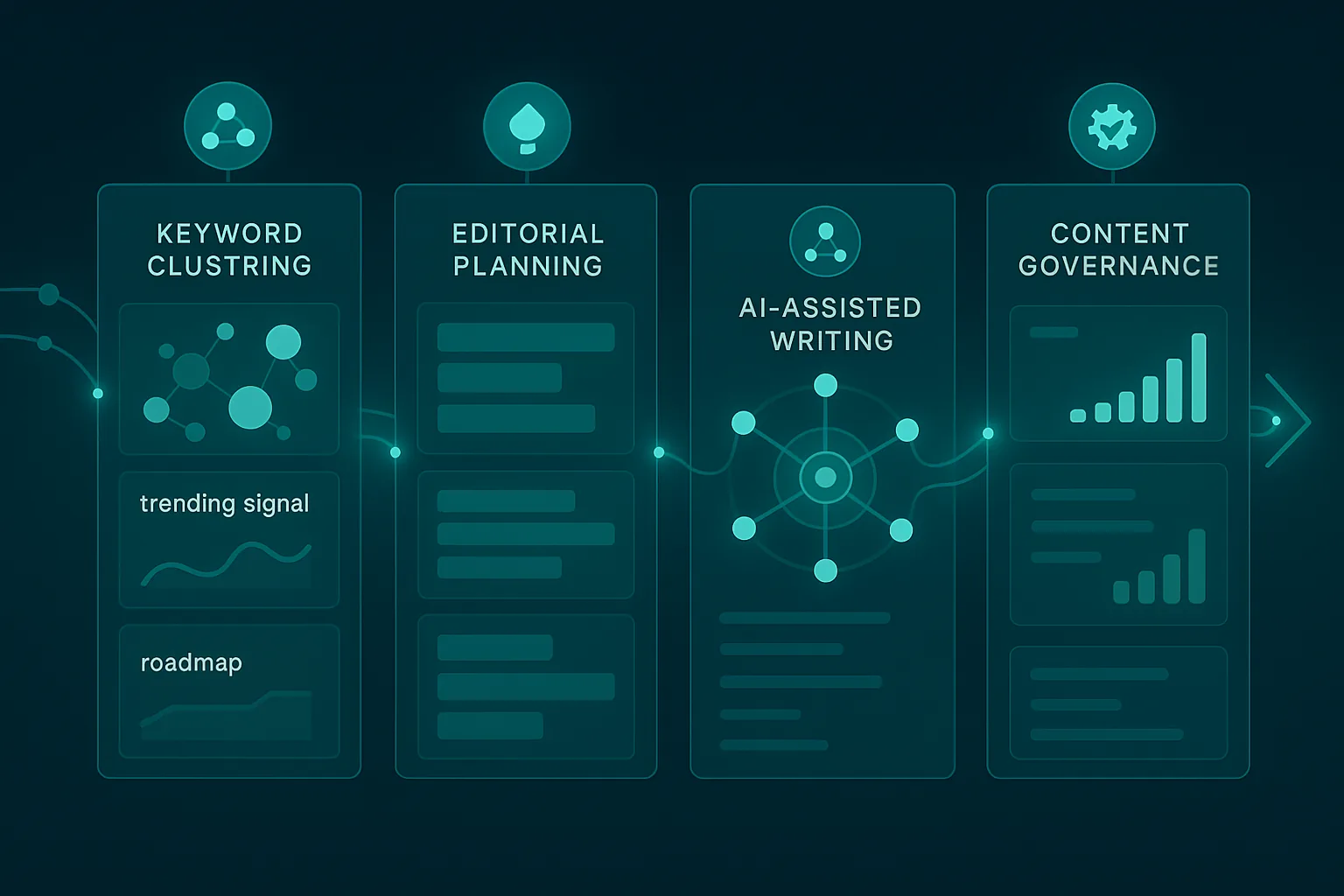
AI Content Governance: How to Govern AI-Generated Content

5 min. read

AI content governance is essential to ensure quality, consistency, and safety. Discover how the Knowledge Layer and Semantic Governance Engine prevent overclaims and maintain entity-safety.

AI Content Governance: How to Govern AI-Generated Content

A practical AI content governance framework for enterprise teams: Knowledge Layer, Semantic Governance Engine and Entity-Safe Publishing — three pillars that keep AI-generated content accurate, brand-safe and consistent at scale.

AI speeds up content production. Without a content governance framework, it also speeds up errors: overclaims, inconsistent brand voice, unverified facts. This guide explains the content governance definition in the AI era, how to define an AI content policy, and how to implement controlled AI content generation across your team.

Content Governance Definition: What It Means in the Age of AI

Content governance is the system of rules, roles and processes that controls how content is created, approved and maintained. In the AI era, this definition expands: you are no longer governing human writers alone — you are governing a system that can produce thousands of content variations in minutes.

A clear content governance definition for AI-assisted teams includes three elements:

  • Ownership: who is responsible for each piece of content and its accuracy.
  • Standards: what quality, tone and compliance rules every output must meet.
  • Workflow: how content moves from AI generation to human review to publication.

Without this structure, AI amplifies existing gaps. Organisations that skip content governance end up with inconsistent brand voice, compliance risks and content that erodes trust rather than building it. The question is not whether to govern AI content — it is how to govern AI-generated content in a way that scales.

How to Define an AI Content Policy: 4 Practical Steps

An AI content policy is the foundation of any content governance framework. It defines what AI can produce, what requires human oversight, and what is off-limits entirely. Here is how to build one in four steps.

01

Map your approved knowledge sources

Knowledge Layer

List every source AI is allowed to draw from: product documentation, verified FAQs, brand guidelines, legal-approved claims. Anything outside this list requires human review before publication.

02

Define approved and forbidden claims

Claim Governance

Explicitly document what AI can state as fact and what it cannot. Forbidden claims typically include unverified statistics, competitor comparisons, and medical or legal advice. Approved claims are pre-validated and stored in your knowledge base.

03

Assign human review checkpoints

Review Workflow

Not all AI content carries the same risk. Define which content types (e.g. product pages, regulatory content, sensitive topics) require mandatory human approval before going live, and which can follow an automated validation path.

04

Integrate validation into your CMS publishing pipeline

Controlled AI Content Generation

Controlled AI content generation only works when governance rules are enforced at the point of publication — not as an afterthought. Connect your AI policy to your CMS so that content failing validation is blocked or flagged automatically before it reaches the live site.

In Brief

In brief: AI content governance definition and key concepts

AI content governance is the system of rules, knowledge sources and automated checks that ensure every AI-generated piece is accurate, brand-safe and consistent with your approved AI content policy. In short: it is how organisations control what AI can say — and what it cannot. A solid content governance framework is the difference between AI that scales your editorial quality and AI that scales your mistakes.

The content governance definition extends here beyond traditional editorial workflows: it covers the automated validation layer that sits between AI generation and live publication, enforcing controlled AI content generation at every step.

  • Content governance definition: the set of policies, roles and workflows that control how content is created, approved and maintained — extended to cover AI-generated output.
  • The Knowledge Layer stores approved claims, brand constraints and verified features — the only facts AI is allowed to state.
  • The Semantic Governance Engine validates every output before publication through five sequential checks, enabling controlled AI content generation at scale.
  • Entity-Safe Publishing guarantees no unverified claim or inconsistent terminology reaches the live site.
  • An AI content governance framework lets content teams scale production without sacrificing accuracy or editorial control.

What is AI Content Governance?

AI content governance is the set of policies, procedures and tools that control how an organization uses AI in content creation and publishing.

Traditional content governance relies on manual editorial workflows. An AI content governance framework must go further, addressing four specific risks:

  • Overclaims — unverified statements generated by AI
  • Semantic inconsistencies — contradictions across different content pieces
  • Loss of editorial control — AI generating text without approved constraints
  • Lack of traceability — no audit trail for sources and model decisions

Without a structured AI content policy, scaling AI production means scaling risk. The solution is a framework that enforces the approved semantic perimeter at every step of generation.

How Does the Knowledge Layer Work in AI Governance?

The Knowledge Layer is a governed semantic knowledge base that maintains approved claims, brand constraints, verified features, and documented proofs. Unlike a traditional content database, the Knowledge Layer is not a passive archive but an active layer that powers AI generation and validates its output.

Each knowledge item in the layer has a reliability tier (1-4, where 1 is official/primary and 4 is user-generated), an approval status for generation (approved_for_generation: true/false), and a human review required flag (requires_human_review).

This approach ensures that AI does not invent arbitrary claims, but only draws from a verified and traceable semantic perimeter.
What is the Semantic Governance Engine and how does it validate content?

The Semantic Governance Engine validates every AI output against the approved semantic perimeter before publication. This is the core of any solid AI content governance framework: it enforces controlled AI content generation through five sequential checks.

  1. Knowledge base matching — every claim must map to an approved knowledge item
  2. Constraint checking — brand constraints and forbidden claims lists are enforced
  3. Semantic coherence scoring — logical consistency across all content sections
  4. Entity-safety validation — correct use of proprietary terminology is confirmed
  5. Retrieval-readiness assessment — structure is evaluated for AI citability (GEO)

Content that fails any check is blocked or flagged for human review. No unverified claim reaches publication.

Related: what AraLith COS is.

What are the fundamental pillars of AI Content Governance?

  • Entity-Safe Publishing

    Ensures that every published content respects the approved semantic perimeter and does not contain unverified claims or inconsistent terminology.

  • Controlled Content Generation

    Workflow that ensures AI accelerates work without introducing overclaims or semantic inconsistencies, while maintaining editorial control.

  • Traceability and audit trail

    Every generated content is traceable: which knowledge items were used, which claims were validated, which sections require human review.

  • Reliability tier system

    4-level reliability system (1=official, 2=industry, 3=general, 4=user-generated) to classify sources and knowledge items.

  • Automatic compliance report

    Every generated content includes a compliance report indicating knowledge items used, unsupported claims, and points requiring human validation.

  • Forbidden claims enforcement

    List of forbidden claims (e.g., unverified numbers, absolute superlatives) that the Semantic Governance Engine automatically blocks before publication.

Frequently Asked Questions: AI Content Governance Framework

AI content governance is the system of rules, knowledge sources and automated checks that ensure every AI-generated piece is accurate, brand-safe and consistent with your approved AI content policy. It covers the full lifecycle: from knowledge sourcing and generation constraints, to validation, publication and ongoing monitoring.

To govern AI-generated content in a CMS, you need three layers working together: (1) a Knowledge Layer that defines what facts and claims AI is allowed to use; (2) a Semantic Governance Engine that validates every output before it reaches the editor; (3) Entity-Safe Publishing rules that block non-compliant content from going live. This is how a CMS like AraLith implements controlled AI content generation natively, without requiring manual review of every piece.

AI-generated content without governance introduces specific risks: overclaim (unverified statements), semantic inconsistencies between different contents, loss of editorial control and difficulty in tracing sources. A dedicated AI content governance framework ensures that controlled AI content generation accelerates work while maintaining quality, consistency and safety.

A practical AI content governance framework has four pillars: (1) a Knowledge Layer with approved claims and brand constraints; (2) a Semantic Governance Engine that validates every output before publication; (3) Entity-Safe Publishing rules that prevent factual drift; (4) a human review loop for high-stakes content. Together, these pillars let teams scale controlled AI content generation without sacrificing accuracy.

Traditional editorial guidelines are static documents that humans follow manually. An AI content governance framework is machine-enforced and dynamic: constraints live in a structured Knowledge Layer, every AI output is validated automatically at generation time, and the system flags or blocks non-compliant content before it reaches publication. The result is consistent controlled AI content generation at scale, regardless of content volume.

The Semantic Governance Engine validates every AI output through five sequential steps: (1) knowledge base matching to verify that every claim maps to an approved knowledge item; (2) constraint checking to respect brand constraints and forbidden claims defined in the AI content policy; (3) semantic coherence scoring; (4) entity-safety validation; (5) retrieval-readiness assessment. Content that does not pass validation is blocked or flagged for human review.

Entity-Safe Publishing is the process that ensures every published piece respects the approved semantic perimeter: no unverified claims, consistent proprietary terminology, respected brand constraints. It is the final enforcement layer of any AI content governance framework, preventing AI from generating statements inconsistent with brand identity.

Yes. AraLith provides a ready-to-use content governance framework structure — including Knowledge Layer configuration, Semantic Governance Engine validation checklist and Entity-Safe Publishing guidelines — directly inside the platform. Book a demo to receive the configuration guide and see how to adapt the framework to your content team’s workflow.

Want to implement AI governance for your content?

Let's talk about how to structure an AI content governance framework for your project

Related insights

Content created with the support of artificial intelligence.