How to Manage Persistent SEO Clusters with Aralith COS

3 min. read

Why SEO clusters break down over time and how Aralith COS transforms them into persistent operational memory across keywords, content, knowledge items, and workflows.

How to manage persistent SEO clusters with Aralith COS

The AI SEO platform that transforms clusters into persistent operational memory

The problem isn't creating SEO ideas. The problem is not losing operational context between one decision and the next.

An SEO cluster stops being useful when keywords, strategic notes, sources, published content, and missing content end up in different places. Aralith COS solves this problem by making the cluster a persistent structure: not a temporary sheet, but operational memory that connects knowledge base, content, and workflows in the same environment. A true AI SEO platform for scalable AI content operations.

Why SEO clusters break down over time

In daily practice, many SEO clusters start well but degrade quickly. Keywords are in one tool, strategic notes in a document, competitors in another, drafts in the CMS, and editorial decisions in internal chats or calls. The result is that every new piece of content almost starts from scratch.

When the cluster isn't persistent, the team loses continuity. Ideas get duplicated, gaps are forgotten, articles disconnect from sources, and it becomes difficult to understand what has already been validated. The problem isn't the lack of insights, but the lack of a structure that keeps them alive over time.

Without an AI SEO platform that unifies strategy and production, persistent SEO clusters remain an aspiration. Every context switch requires manual reconstruction, and AI content governance becomes impossible to scale. SEO orchestration requires operational memory, not just planning.

AI content operations only work when the system preserves context between different sessions. Otherwise, every editorial decision starts from scratch, and the cluster becomes a static artifact instead of a living resource.


The cluster must become a living object within the system

What truly makes an SEO cluster persistent

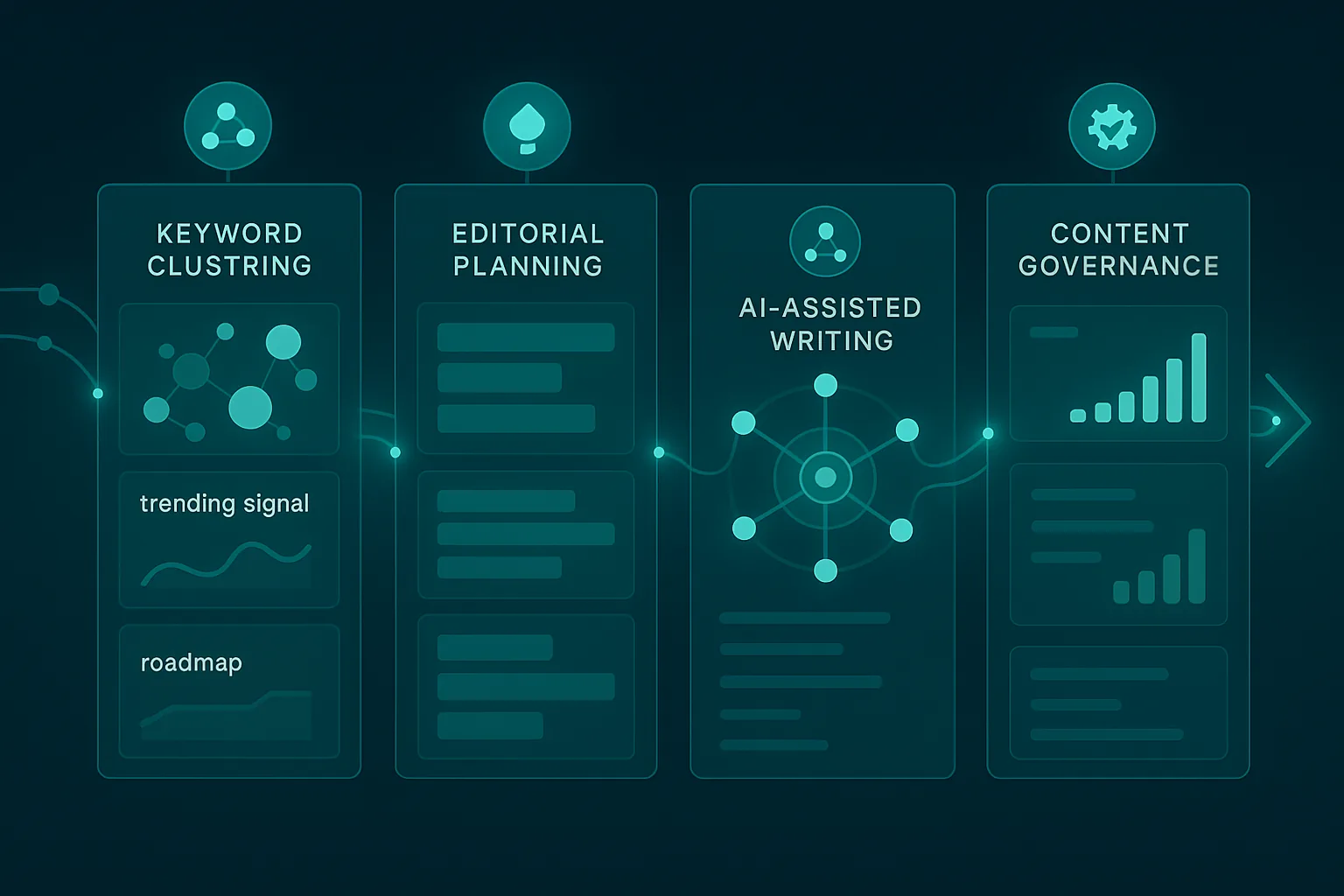
To remain useful, a cluster must connect at least four operational levels:

  • topic and intent, to understand why that cluster exists
  • knowledge items and sources, to not lose strategic assets
  • linked content, to immediately see what has already been produced
  • gaps and next moves, to transform the cluster into an editorial roadmap

Aralith CMS works exactly on this point: the cluster doesn't remain a planning artifact, but becomes the coordination point between strategy, memory, and production.

SEO orchestration requires that every cluster be connected to verified knowledge items, published content, and active workflows. Only then can AI content governance operate on structured data instead of scattered sheets. AI content operations scale when the system preserves context between different sessions, and the AI SEO platform becomes the single source of truth for the entire team.

Aralith dashboard with SEO clusters and linked content

Three signs the cluster has become operational

1

Source of truth

4

Connected levels

0

Out-of-context decisions

FAQ about Persistent SEO Clusters

It means the cluster doesn't live in an isolated file but in a structure that preserves keywords, intent, knowledge items, related content, and open gaps over time.

Because it doesn't stably connect strategy, memory, and production. As soon as the context changes, the team has to rebuild connections and decisions already made.

Aralith centralizes clusters, content, sources, and workflows in the same COS, reducing context dispersion and unnecessary rework.

Want to transform clusters into operational memory?

Aralith COS connects knowledge base, content, and workflows in the same system, so the cluster stays alive and useful even as the team scales.

Related Insights

Content created with the support of artificial intelligence.