How to Manage Persistent SEO Clusters with Aralith COS
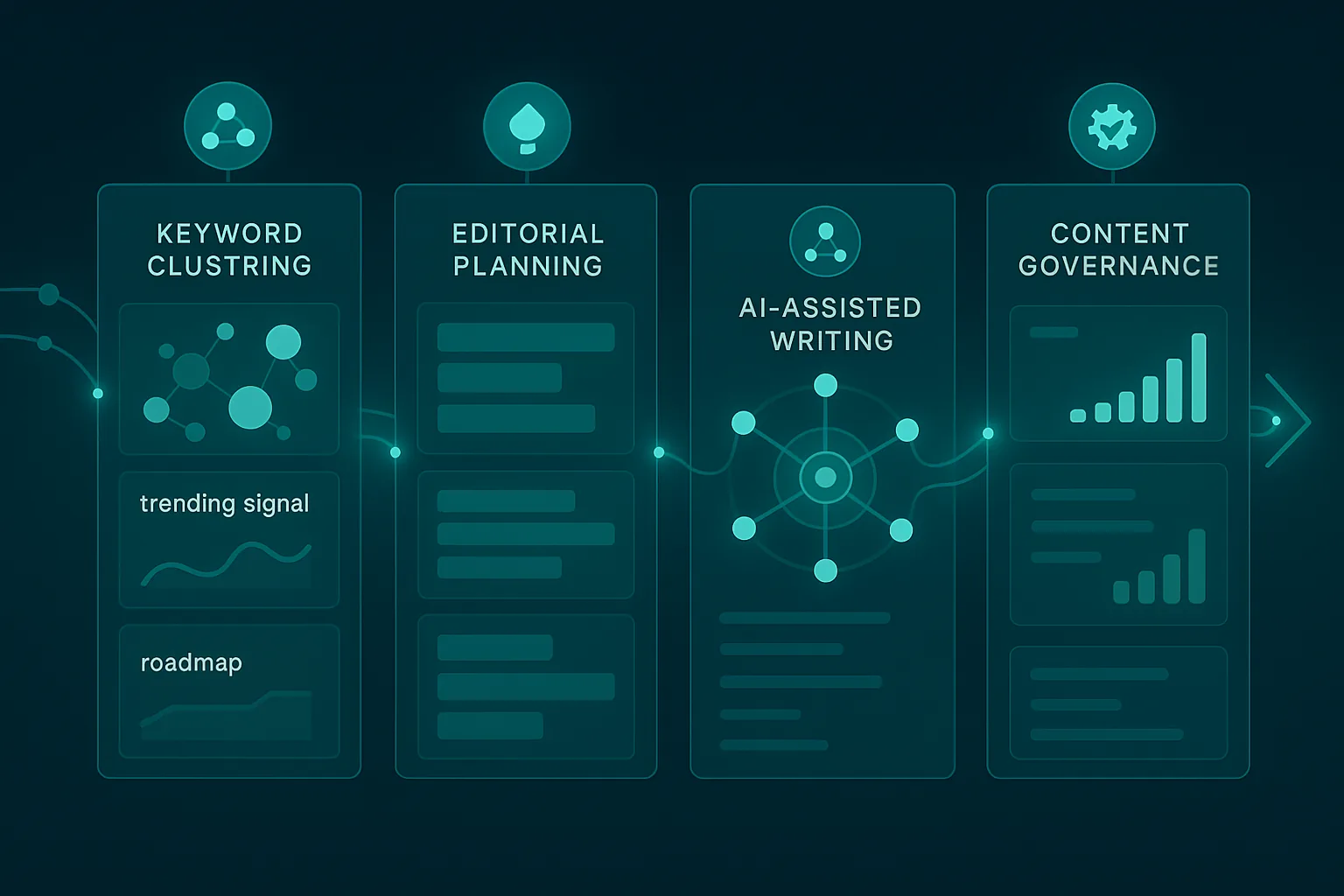
Why SEO clusters break down over time and how Aralith COS transforms them into persistent operational memory across keywords, content, knowledge items, and workflows.
Read the article
The question is not which CMS is best. It is who carries the maintenance, and what the full stack costs.
WordPress works: in 2025 its core had 6 vulnerabilities in the whole year. The weight sits in the stack that grows around it — plugins, subscriptions and separate tools to keep updated. Below: the seven real alternatives, the point-by-point comparison, and the cases where staying on WordPress is the right call. Data verified in September 2026.
For: design-led sites, with a team that knows how to use it.
Pixel-level visual control, a CMS of up to 20,000 items on the Premium plan, localisation with translated slugs. In 2026 it added generative-search audits and a server for AI agents.
For: landing pages and small sites you want live quickly.
Fast to build and solid SEO basics. Two limits worth knowing upfront: it does not translate slugs, so URLs stay in the source language, and the CMS stops at 2,500 items on the Pro plan.
For: local businesses and brochure sites that have to stand on their own.
Everything included and no maintenance on your side. In exchange, little control over technical detail and a ceiling you feel once content grows.
For: selling online, with the store at the centre of the project.
If ecommerce is the core of the business, a platform built for it solves more problems than a general-purpose CMS with a selling plugin on top.
For: publishing a lot and living off readers, with newsletters and subscriptions.
It is built around writing rather than around corporate pages: it does few things and does them well.
For: teams with developers, where the site is part of a digital product.
Almost total freedom on the frontend, in exchange for development and maintenance that stay yours. Without a stable dev team it becomes a cost, not an advantage.
For: teams publishing continuously, often in several languages, who need to say who approved what.
Content, SEO and the AI assistant in one environment, with hosting and updates in the subscription. The AI writes inside a perimeter of approved facts and, on a published language, nothing goes live without review.
There is no absolute winner among WordPress alternatives: it depends on what you are building and on how much it costs you to make your tools talk to each other. Data verified in September 2026 against the vendors' public sources and the annual Patchstack report.
| Setup and cost | WordPress | AraLith COS |
|---|---|---|
| Who carries the maintenance | You or your agency: 11,334 vulnerabilities in 2025, 91% in plugins | The vendor: hosting and updates included in the subscription |
| Recurring cost beyond hosting | Premium plugins on top (Polylang Pro €99/year, Yoast Premium $118.80/year) | A single subscription; AI is paid per use, in euro |
| Ecommerce | WooCommerce, a mature ecosystem | Not available |
| Themes and design freedom | Thousands of ready-made themes | A bespoke theme can be built, within the builder components |
| Extension ecosystem | Tens of thousands of plugins | Closed catalogue: if it is missing, it has to be built |
| Code ownership | GPL licence, your own installation | No: SaaS subscription |
| Content and AI | WordPress | AraLith COS |
|---|---|---|
| SEO and structured data | Plugins (Yoast, Rank Math...) | Native: JSON-LD derived from the page type and the components used |
| Perimeter around AI-written content | None: plugins generate with no source constraint | Approved knowledge base and declared claims |
| Human review of AI output | Depends on the roles configured | Mandatory on languages already published |
| Content losing ground | No native feature | Detection on Search Console data, with a recovery plan proposed |
| Import from WordPress | — | Via REST API: text, titles, basic SEO and images. The layout has to be rebuilt |
| Community and developers | Huge, two decades deep | Young product, no third-party community |
Looking for WordPress alternatives does not mean WordPress is wrong. There are cases where staying is the most rational choice:
AraLith COS is the WordPress alternative CMS best suited when content is the main asset and has to be governed, not just published:
In AraLith COS the assistant works on Google Search Console, Analytics, Ubersuggest, SERP and AI Overview data without leaving the dashboard. These features depend on the matching connections: without Search Console, SerpAPI or Ubersuggest credentials, the corresponding feature does not run. Better said upfront than discovered later.
Clicks, impressions, CTR and positions for every piece of content, read by the assistant inside the dashboard. Requires a Search Console connection.
Checks whether the site is cited in AI Overviews and in Claude and ChatGPT answers, including the competitor sources cited instead of yours. Requires a SerpAPI key.
A 0 to 100 score built on clicks, impressions, position and freshness, with a recovery plan proposed in chat. It is a rule-based estimate, not a verdict, and it needs at least two data collections.
Pages and posts from the source site's REST API, with images pulled into the local library. It does not bring comments, taxonomies, menus, forms or banners, and the text arrives as a single block to rebuild.
The assistant writes inside a declared perimeter: company profile, allowed and forbidden claims, approved facts with a reliability tier and an expiry date.
There is no third-party extension library to keep aligned: the surface is the product itself, and updates come with hosting inside the subscription.
Google Search Console data for medichub.it, measured over the 28 days following the migration and the optimisation work. This is a single case, reported with the site and the period attached: it is not an average result, nor a forecast of what another project would achieve.
Organic clicks
Impressions
Average position
Detected period
There is no single answer, and be wary of anyone who gives you one. It depends on the project: for a complex ecommerce, WordPress with WooCommerce remains the most mature choice; for a design-led site there are the visual builders; for teams publishing continuously who need to say who approved what, AraLith COS keeps content, SEO and the AI assistant in the same environment. The criterion that weighs most is not the feature list: it is who carries the maintenance.
Yes, if the site exposes its own REST API. The wizard brings across pages, posts, titles, basic SEO and images, recognises content already imported and never creates duplicates. It does not bring comments, taxonomies, menus, contact forms or cookie banners, it does not translate, and the text arrives as a single block to rebuild in the editor. If the site does not expose wp-json, the import does not start: there is no generic crawling fallback.
Yes, and it is still the most widely used CMS in the world. Its core is solid: in 2025, 6 vulnerabilities were found in the core against more than 10,000 in plugins (Patchstack, 2026). The weak point is not the platform, it is the stack that grows around it and the fact that somebody has to maintain it every week.
It compares Search Console data over time and gives each piece of content a score from 0 to 100 combining click loss, impression loss, position decline and freshness, flagging what is losing ground. From there you can ask the assistant for a recovery plan, which stays a proposal until it is approved. It needs at least two data collections, and it is a rule-based estimate rather than a final verdict.
The perimeter. A text generator installed as a plugin has no approved set of facts to stay within: it produces plausible content, not necessarily true content. In AraLith COS the assistant writes inside a company profile with allowed and forbidden claims and uses only approved knowledge; on a language already published nothing goes live on its own, not even writes coming from an external agent connected to the platform.
No. AraLith COS does not include an ecommerce engine: if the main project is an online store with advanced requirements, WordPress with WooCommerce remains the more mature choice. AraLith COS is built for editorial sites, service pages, blogs and company websites where content and SEO carry the weight.
No. It is a SaaS subscription product: the platform code stays with AraLith. The content you publish is yours, but there is no perpetual licence, no version you can install on your own servers and no source code escrow. If owning the code is a requirement, the right answer is WordPress or custom development.
The product is young and there are no verified numbers on customers or average results to show. The catalogue of page structures exists and is documented, but it is being validated right now, on live projects. AraLith has been building software since 2007: that is the experience behind it, while the maturity of this specific product is still being built.
We will work out together what it costs to keep it running and what would change by governing it from a single environment. If staying where you are is the better call, we will tell you.
Discover AraLith COS, the Content Operating System that unifies CMS, SEO, AI and governance in a single platform.
How AraLith COS handles AI governance with built-in editorial control, transparency and compliance.
Everything you need to know about AI credits: how they are consumed, recharged and optimised.
A comparison between traditional SEO tools and AraLith COS: why native integration changes everything.
Request a personalised quote for your website with AraLith COS. Explore plans and pricing.
Why SEO clusters break down over time and how Aralith COS transforms them into persistent operational memory across keywords, content, knowledge items, and workflows.
Read the articleWhy SEO teams lose continuity switching from one tool to another and how Aralith COS reduces context switching by unifying strategy, content and workflow.
Read the articleWhere SEO teams really waste time and why Aralith COS helps recover it by connecting strategy, execution, and publishing in the same workflow.
Read the articleContent created with the support of artificial intelligence.